Immune System as a Treatment Target

Immune System as a Treatment Target

The immune system has become a target for cancer treatments in recent years.1 The body’s immune system can detect and destroy abnormal cells and most likely prevent or slow the growth of many cancers.1 However, cancer cells can avoid destruction by the immune system.1 Immunotherapy has emerged as a type of cancer treatment that helps the immune system fight cancer.1 There are several types of immunotherapy, including immune checkpoint inhibitors, chimeric antigen receptor (CAR) T-cell therapy, monoclonal antibodies, vaccines, and immune system modulators.2

Immune Checkpoint Inhibition

Immune checkpoint inhibitors block checkpoint proteins, which allows immune cells to exhibit a stronger response to cancer.1-4 Immune checkpoint inhibitors are approved by the US Food and Drug Administration (FDA) for intravenous infusion to treat patients with various cancers, including breast cancer, cervical cancer, colon cancer, head and neck cancer, Hodgkin lymphoma, liver cancer, lung cancer, skin cancer, and other solid tumors.3 Drugs that target different checkpoint proteins are currently used to treat different types of cancer.4

CTLA-4

CTLA-4 is a checkpoint protein on T cells that acts as an “off” signal for T cells, reducing their activity.1,4 CTLA-4 inhibitors block the off-switch, allowing the immune system to target cancer cells. CTLA-4 inhibitors include ipilimumab, the first immune checkpoint inhibitor approved by the FDA, and tremelimumab-actl.4 These drugs are used to treat advanced melanoma and other cancers, in combination with a PD-1 or PD-L1 inhibitor.4,5

PD-1 and PD-L1

Another checkpoint protein, PD-1, plays a major role in regulating immune responses in peripheral tissues. Binding of PD-1 to its ligands PD-L1 and PD-L2 suppresses T-cell activation and function, leading to a diminished immune response against tumor cells.6 Therapies that target PD-1 or PD-L1 inhibit this binding and restore antitumor immune response.4 Several PD-1 inhibitors are currently FDA-approved for treatment of various malignancies, alone or in combination with other agents and across many disease settings. These include the PD-1 inhibitors pembrolizumab, nivolumab, cemiplimab, dostarlimab-gxly, penpulimab-kcqx, retifanlimab-dlwr, and tislelizumab-jsgr, and the PD-L1 inhibitors atezolizumab, avelumab, and durvalumab.4,5
LAG-3

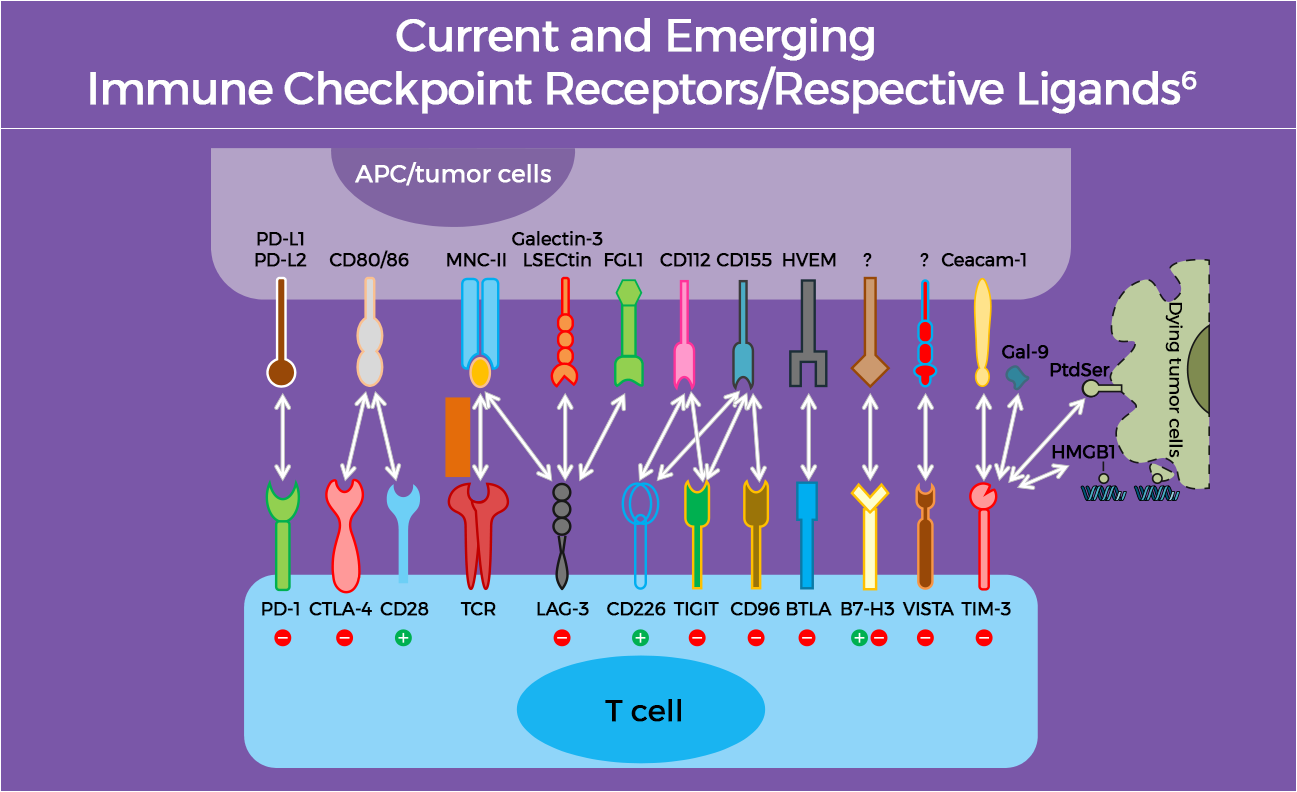
LAG-3 works synergistically with PD-1 to induce immune suppression.7-9 Targeted combination therapy may help overcome immune evasion.7-9 A LAG-3 inhibitor, relatlimab, is approved in combination with nivolumab as a fixed-dose combination for advanced melanoma.8 This target is also being evaluated for lung, colorectal, liver, and esophageal or gastric cancers, multiple myeloma, and chordoma.9 The figure depicts current and emerging immune checkpoint receptors and their ligands.

Research continues to focus on other checkpoint proteins and developing drugs that can be used to target them.5,6,10-12 

Bispecific Antibodies (BsAbs):9

Antibody-based therapies have transformed the field of oncology by enabling selective targeting of specific oncogenic pathways and enhanced immune responses. Antibody-based therapy has rapidly evolved from naked monoclonal antibodies to BsAbs, which are increasingly being incorporated into clinical practice. BsAbs are engineered to bind two different targets at the same time, with the aim of synergizing pathway inhibition, overcoming resistance, and activating immune effector cells. Several BsAbs are already available and have shown promising efficacy across a wide range of cancer types.

Examples of currently available BsAbs are listed below:

  • BCMA x CD3-targeted BsAbs for relapsed/refractory multiple myeloma include linvoseltamab, teclistamab, and elranatamab
  • CD20 × CD3 BsAbs: several BsAbs targeting CD20 and CD3 are currently used in the relapsed/refractory setting in B-cell lymphomas including mosunetuzumab (follicular lymphoma [FL]), glofitamab (diffuse large B-cell lymphoma [DLBCL]), and epcoritamab (FL, DLBCL). Odronextamab is another CD20 × CD3 BsAb that is approved for FL and DLBCL in Europe
  • GPRC5D × CD3: talquetamab is approved for relapsed/refractory multiple myeloma
  • CD19 × CD3 BiTE: blinatumomab is approved for B-cell precursor acute lymphoblastic leukemia
  • EGFR × MET: Amivantamab is approved for EGFR-mutant non-small cell lung cancer
  • DLL3 X CD3: tarlatamab is approved for relapsed/refractory small cell lung cancer

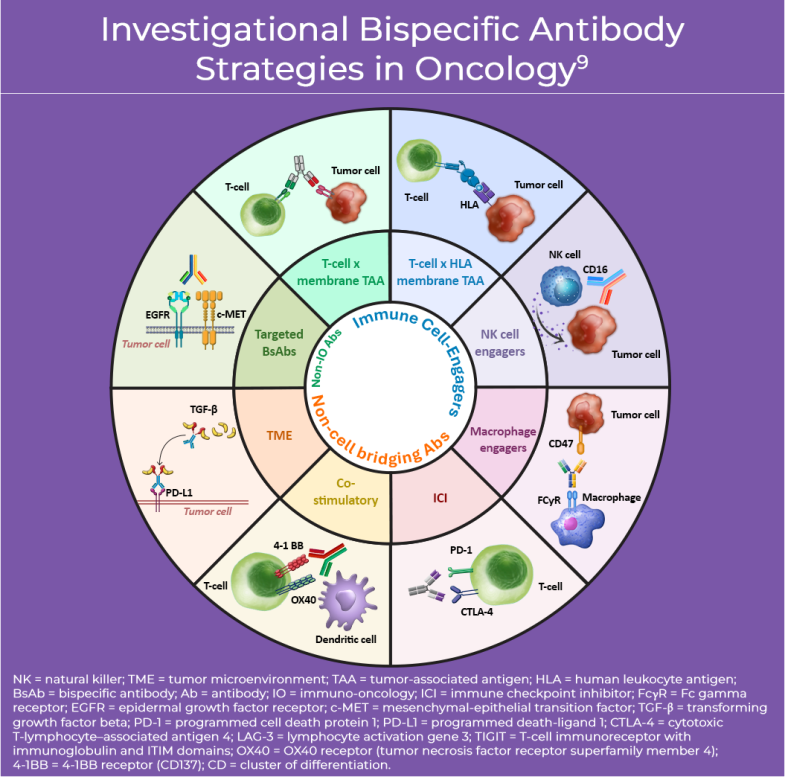
BsAbs are categorized into three functional classes: immune cell engagers, non-cell bridging antibodies, and non-immune-oncology (non-IO) antibodies.

  • Immune cell engagers: T-cell engagers target tumor-associated antigens (TAA) or HLA-restricted TAAs, natural killer (NK) cells, and macrophages
  • Non–cell bridging antibodies: engage co-stimulatory agonists, immune checkpoint inhibitors, and tumor microenvironment modulators; unlike immune cell engagers, these agents do not create direct physical links between immune effector cells and tumor cells but instead work by blocking inhibitory checkpoints (eg, PD-L1, CTLA-4) or activating co-stimulatory pathways (eg, OX40) to enhance immune responses
  • Non-IO antibodies: targeted therapies that block oncogenic signaling pathways (eg, EGFR, MET, MUC16, PSMA) rather than directly engage the immune system

Broad development of BsAbs is rapidly evolving from use with hematological malignancies to solid tumors, with a vast number of targets being explored across disease states. The figure below highlights promising dual targeted approaches currently under investigation.

Investigational Bispecific Antibody Strategies in Oncology9

Chimeric Antigen Receptor (CAR) T-cell Therapy

CAR T-cell therapies have reshaped the treatment of relapsed/refractory B-cell malignancies, multiple myeloma, and acute lymphoblastic leukemia by enabling activated T-cells to directly recognize, target, and destroy tumor cells.13,14

  • CD19-directed CAR T products are approved for use in relapsed/refractory B-cell malignancies (axicabtagene ciloleucel, tisagenlecleucel, lisocabtagene maraleucel, and brexucabtagene autoleucel)
  • BCMA-directed CAR T products for relapsed/refractory multiple myeloma include idecabtagene vicleucel and ciltacabtagene autoleucel

CAR T-cell production involves engineering the patient’s T-cells to express CARs that are programmed to target tumor-associated antigens.13-15 CAR T-cell therapy involves infusion at a specialized CAR T facility followed by close monitoring for at least two weeks (daily monitoring for one week) for immune-mediated toxicities including cytokine release syndrome, immune effector cell-associated neurotoxicity syndrome, and CAR-related encephalopathy syndrome. In addition, the patient must remain within close proximity of the CAR T center for four weeks afterward.15,16

Oncolytic Viruses

Oncolytic viral therapy refers to the use of viruses, either genetically engineered or in their natural form, to infect, selectively replicate within, and kill cancer cells while sparing healthy tissue. The first FDA-approved therapy, talimogene laherparepvec, is an intralesionally administered herpes simplex virus used for treatment of unresectable or recurrent advanced melanoma. Several oncolytic viruses are currently under development for advanced melanoma, both as monotherapy or in combination with a PD-1 inhibitor. Vidutolimod is an investigational virus-like particle that acts as a potent toll-like receptor 9 (TLR9) agonist and is being studied in advanced and recurrent melanoma.17,18 Vidutolimod recently showed promising safety and efficacy in the neoadjuvant setting in combination with pembrolizumab.18

References

  1. National Cancer Institute. Immunotherapy to Treat Cancer. Updated September 24, 2019. https://www.cancer.gov/about-cancer/treatment/types/immunotherapy
  2. Cleveland Clinic. Immunotherapy. Last reviewed August 12, 2025. https://my.clevelandclinic.org/health/treatments/11582-immunotherapy
  3. National Cancer Institute. Immune Checkpoint Inhibitors and Their Side Effects. Reviewed April 7, 2022. https://www.cancer.gov/about-cancer/treatment/types/immunotherapy/checkpoint-inhibitors
  4. American Cancer Society. Immune Checkpoint Inhibitors and Their Side Effects. Last Revised: December 15, 2025. https://www.cancer.org/treatment/treatments-and-side-effects/treatment-types/immunotherapy/immune-checkpoint-inhibitors.html
  5. The University of Texas MD Anderson Cancer Center. Which cancers can be treated with immune checkpoint inhibitors? February 05, 2024. https://www.mdanderson.org/cancerwise/what-cancers-can-be-treated-with-immunotherapy.h00-159695178.html
  6. Qin S, Xu L, Yi M, Yu S, Wu K, Luo S. Novel immune checkpoint targets: moving beyond PD-1 and CTLA‑4. Mol Cancer. 2019;18:155.
  7. U.S. Food & Drug Administration. FDA Approves Opdualag for Unresectable or metastatic melanoma. March 18, 2022. https://www.fda.gov/drugs/resources-information-approved-drugs/fda-approves-opdualag-unresectable-or-metastatic-melanoma
  8. Winstead E. National Cancer Institute. Opdualag Becomes First FDA-Approved Immunotherapy to Target LAG-3. Cancer Currents Blog. April 6, 2022. https://www.cancer.gov/news-events/cancer-currents-blog/2022/fda-opdualag-melanoma-lag-3
  9. Fontana E, Grochot R, Kotecki R, et al. Evolution of bispecific and multispecific antibodies in cancer therapy. Lancet Reg Health Eur. [Epub ahead of print March 19, 2026].
  10. Licciulli S. American Association for Cancer Research. Experts Forecast Cancer Research and Treatment Advances in 2023. Cancer Research Catalyst. January 13, 2023. https://www.aacr.org/blog/2023/01/13/experts-forecast-cancer-research-and-treatment-advances-in-2023/
  11. Cancer Research Institute. Immunotherapy: Immunomodulators: Checkpoint Inhibitors, Cytokines, Agonists and Adjuvants. https://www.cancerresearch.org/treatment-types/immunomodulators
  12. Carter D. The University of Texas MD Anderson Cancer Center. LAG-3 Inhibitors: A New type of Immunotherapy. November 30, 2022. https://www.mdanderson.org/cancerwise/lag-3-inhibitors–a-new-type-of-immunotherapy.h00-159544479.html
  13. Vinoo S, Jaiswal D, Mehta P, et al. Living medicines engineered to fight: A comprehensive review on CAR T-cell therapy. Int J Hematol Oncol Stem Cell Res. 2025;19:180-190. doi:10.18502/ijhoscr.v19i2.18555
  14. Zugasti I, Espinosa-Aroca L, Fidyt K, et al. CAR-T cell therapy for cancer: current challenges and future directions. Signal Transduct Target Ther. 2025;10:210. doi:10.1038/s41392-025-02269-w
  15. Zhang C, Durer S, Thandra KC, Kasi A. Chimeric antigen receptor T-cell therapy. Last update October 3, 2022. StatPearls. https://www.ncbi.nlm.nih.gov/books/NBK537294/
  16. FDA eliminates REMS for autologous CAR T cell immunotherapies. June 26, 2025. https://www.fda.gov/vaccines-blood-biologics/safety-availability-biologics/fda-eliminates-risk-evaluation-and-mitigation-strategies-rems-autologous-chimeric-antigen-receptor
  17. Houghton M, Houldsworth A. Investigating the potential of oncolytic viruses in the treatment of melanoma: where do we go from here? Skin Health Dis. 2025;5:102-113. doi:10.1093/skinhd/vzaf022
  18. Tarhini AA, Lee SJ, Davar D, et al. A phase II randomized study of neoadjuvant pembrolizumab (P) alone or in combination with vidutolimod (V) in high-risk resectable melanoma: ECOG-ACRIN EA6194. J Clin Oncol. 2025;43(17_suppl):LBA9505.

ALL URLs accessed April 3, 2026

Pin It on Pinterest

Directory
Scroll to Top